It's the week before review season. You've got a Slack DM open to three different managers asking, "Hey, do you have any notes on Jamie from this year?" One manager says "she's great, communicates well overall." Another can only remember the project from last month. Nobody remembers March.
This is the moment a lot of HR leaders start Googling "Culture Amp alternative". Not because Culture Amp is bad at what it does — it's genuinely strong at employee engagement surveys — but because surveys were never designed to solve this problem. Surveys tell you how people feel right now. They don't tell you what a manager actually said about a specific project in Q2, and they definitely don't replace the year of context that gets lost between review cycles.
If you're evaluating Culture Amp or coming up for renewal, it's worth being clear-eyed about what kind of tool you actually need: one that measures sentiment periodically, or one that captures performance evidence continuously. They're related problems, but they're not the same problem, and conflating them is how teams end up with a platform that's well-loved for engagement pulses and still useless on review day.
For a feature-by-feature view of where the products overlap and where they differ, see our full WorkStory vs. Culture Amp comparison.
Survey-First vs. Continuous Feedback: What's the Real Difference?
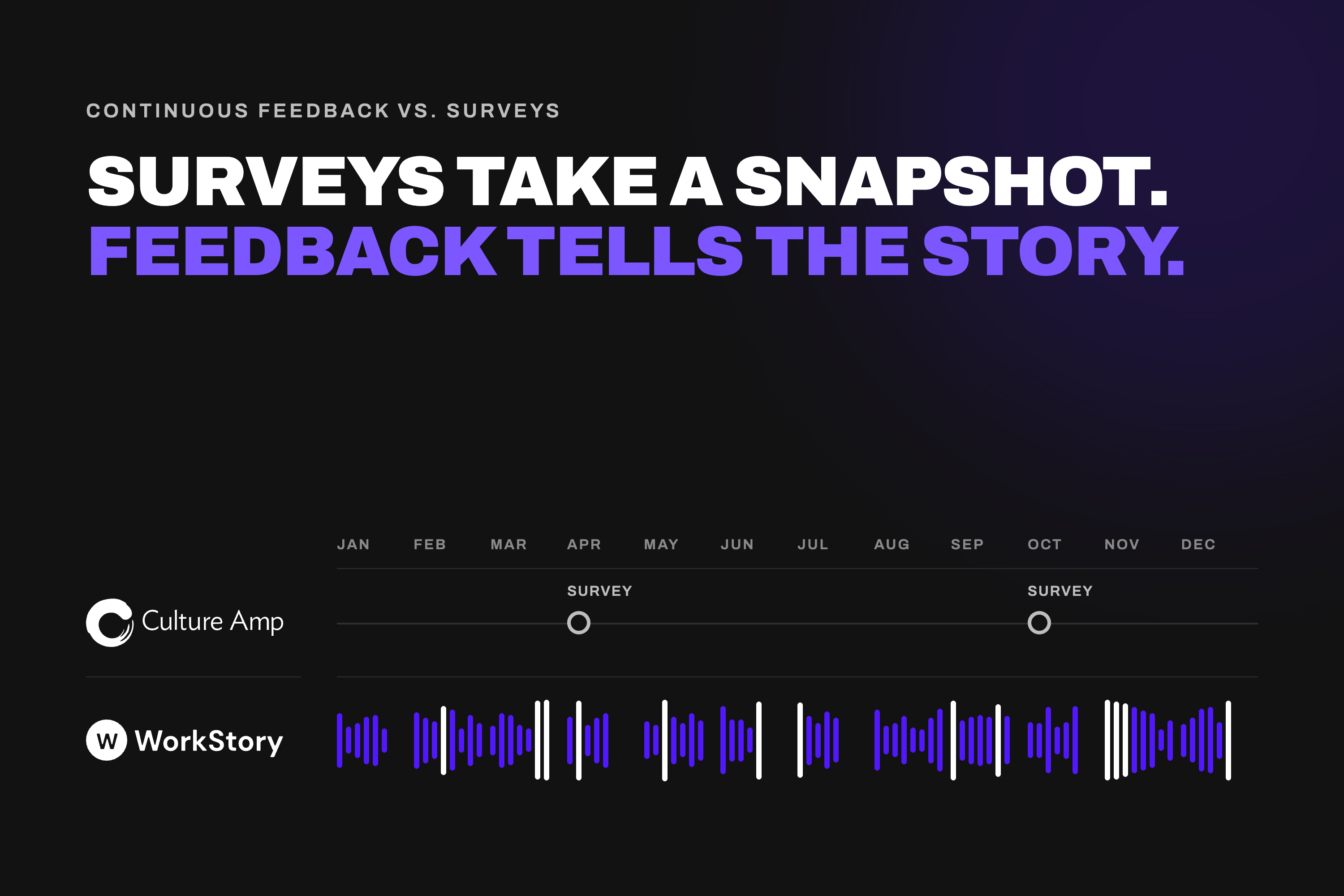
Culture Amp, like most of the platforms that get grouped with it, is fundamentally survey-first. You send out an engagement survey, a pulse check, or a 360 review request, people respond within a window, and you get a report. That's valuable for measuring sentiment and benchmarking culture over time.
But a survey is a snapshot. It captures how someone feels when you ask the question — not the specific, evidence-backed examples of what they did well or where they struggled throughout the year. That's the gap continuous feedback tools are built to close.
WorkStory takes a different approach entirely. Instead of scheduling a moment to ask people how things are going, it collects feedback continuously, in Slack, Microsoft Teams, Webex, and email — the tools your team is already using all day, every day. A manager can send a quick piece of feedback about a specific project the moment it happens, instead of trying to reconstruct it eight months later from memory.
That distinction matters more than it sounds like it should, because it changes what your review data actually looks like. Survey-first tools give you sentiment trends. Continuous feedback gives you a documented record you can point to.
Why HR Leaders Search for a Culture Amp Alternative
A few patterns show up again and again when People Ops leaders start looking elsewhere:
1. Reviews still take hours to assemble.
Even with engagement data in hand, someone still has to go build the actual performance review — chasing down specifics across calendars, chat logs, and project tools. That research phase eats most of the time managers spend on reviews, when the real value is in the coaching conversation, not the digging.
2. One or two cycles a year means recency bias wins.
If your only structured touchpoints are a mid-year and annual review, promotion and comp decisions quietly get built on whatever happened in the last six to eight weeks. Twelve months of work gets flattened into whatever's freshest in a manager's memory. We wrote a full breakdown of how recency bias shows up in performance reviews if that pattern sounds familiar.
3. Generic, boilerplate write-ups.
"Communicates well overall." "Meets expectations." These phrases show up constantly not because managers are lazy, but because gathering specific, evidence-backed examples takes real effort — effort most managers don't have time for in a single sitting.
4. Inconsistent ratings across managers, with no calibration net.
One manager's "exceeds expectations" is another's "meets expectations," and without a structured calibration step, that inconsistency just quietly ships through to comp decisions.
5. Adoption risk.
Nobody wants to buy "yet another platform" that employees ignore. If feedback capture requires people to log into a new portal, adoption drops. That's part of why survey fatigue is a real, recurring complaint about engagement platforms generally — people get asked to fill out one more form.
How WorkStory Works as a Continuous Alternative
Rather than positioning itself as a feature-for-feature Culture Amp clone, WorkStory is built around a different core mechanic: automatic, continuous feedback capture that turns into structured reviews without the manual assembly work. Here's how it actually runs:
- Feedback prompts go where people already work. WorkStory sends automated prompts through Slack, Microsoft Teams, Webex, and email — no separate login, no new habit to build.
- Managers, peers, and self-reviewers respond in the flow of work. A quick note about a specific project takes seconds, right inside the same chat thread where the work happened.
- Feedback accumulates on live dashboards. Sentiment analysis and category trends build up automatically over weeks and months — not just in the two weeks before a review is due.
- AI compiles the accumulated feedback into a structured, bias-reduced draft. Instead of a blank document and a memory problem, managers start with a real draft built from real, dated feedback — a starting point they still review, edit, and own before anything is finalized.
- Calibration tools flag rating inconsistencies before reviews finalize. If one manager's ratings run consistently higher or lower than a peer's, that's visible and reconcilable before it reaches a comp conversation.
- Goal tracking, pulse surveys, and the WorkStory MCP integration layer on top. HR, managers, and employees can query performance data conversationally inside ChatGPT or Claude — useful for building growth plans or prepping a 1:1 agenda without digging through a dashboard first.
The result: reviews built from real feedback specific enough to actually mean something — "Jamie proactively flagged the timeline risk on the Meridian account two weeks early" instead of "communicates well overall" — because that comment was captured the week it happened, not reconstructed from memory in December.
If you want the fuller picture of what this model replaces, we go deeper in Continuous Feedback: The Complete Guide.
What This Means for the December Conversation
The single most disruptive thing about only reviewing performance once or twice a year is that twelve months of misaligned expectations get revealed all at once, in one meeting, and that meeting has maybe 60 minutes to cover roughly 2,000 hours of work. That's a structural problem, not a people problem — no manager, however well-intentioned, can distill a year in an hour without something getting lost or landing as a surprise.
When feedback is continuous, the annual (or quarterly) conversation stops being a reveal and starts being a recap. Nothing in it should be new, because the manager and employee have both seen the pattern building for months. That's the practical case for continuous feedback over a survey-first cadence: it's not that surveys are wrong, it's that they weren't designed to solve the documentation problem in the first place.
For a deeper look at why the once-a-year model breaks down structurally, see our guide to performance reviews and how continuous feedback changes the process.
Where WorkStory Isn't the Right Fit
Worth saying plainly, in the spirit of not overselling this: if what you need is deep, dedicated engagement-survey science — anonymous benchmarking across a large, partly non-desk workforce, industry-level sentiment comparisons, that sort of thing — a dedicated engagement platform may still serve that specific job better. WorkStory isn't trying to be an engagement-survey replacement; it does include pulse and engagement surveys, but its core strength is performance documentation and review generation, not survey science.
If you're comparing several performance-focused tools side by side, it's also worth reading how other platforms stack up: see our comparisons of WorkStory vs. Lattice and WorkStory vs. 15Five for a sense of how the category is priced and positioned.
FAQ
How good is Culture Amp?
Culture Amp is a well-regarded platform for employee engagement surveys and sentiment benchmarking. Where teams often run into limits is on the performance-review side: surveys measure how people feel at a point in time, not the specific, evidence-backed record of what someone actually did across the year. That's a different job, and it's why some HR teams pair or replace survey tools with a continuous feedback platform for review season.
What does a Culture Amp alternative cost compared to WorkStory?
Pricing varies by vendor and by how many modules you need — engagement, performance, learning, development, and more. WorkStory's Business plan is $10 per user per month, with custom Enterprise pricing available for larger organizations at a minimum annual contract of $3,600. For the more detailed side-by-side, read the WorkStory vs. Culture Amp comparison.
What is the best employee engagement software?
It depends on the job you're hiring the software for. If your priority is engagement-survey science and culture benchmarking, a dedicated survey platform may fit best. If your priority is turning year-round feedback into structured, ready-to-use performance reviews without manual assembly, a continuous feedback platform like WorkStory is built for that specific problem instead.
Do employees actually use continuous feedback tools, or do they ignore them like another survey?
Adoption tends to be higher when feedback capture happens inside tools people already use all day — Slack, Microsoft Teams, Webex, email — rather than requiring a new portal login. That's the core design choice behind WorkStory: feedback happens where work already happens, so there's no new habit to build.
Can AI-generated review drafts be trusted, or do managers still need to review them?
AI-generated drafts are meant to be a starting point, not a finished product. WorkStory's AI compiles accumulated feedback into a structured, bias-reduced draft, but managers still read, edit, and finalize every review — the tool removes the blank-page and research problem, not the manager's judgment.
Related resource: Compare WorkStory vs. Culture Amp for the side-by-side breakdown of pricing, use cases, and tradeoffs.